Planning permission for extensions
We find the right route and handle the application: permitted development, prior approval or full planning.
- Guide price£350 to £1,600 inc VAT
- Design and approvals8–13 weeks typical decision period
- Planning in EnglandWe find the right route for you
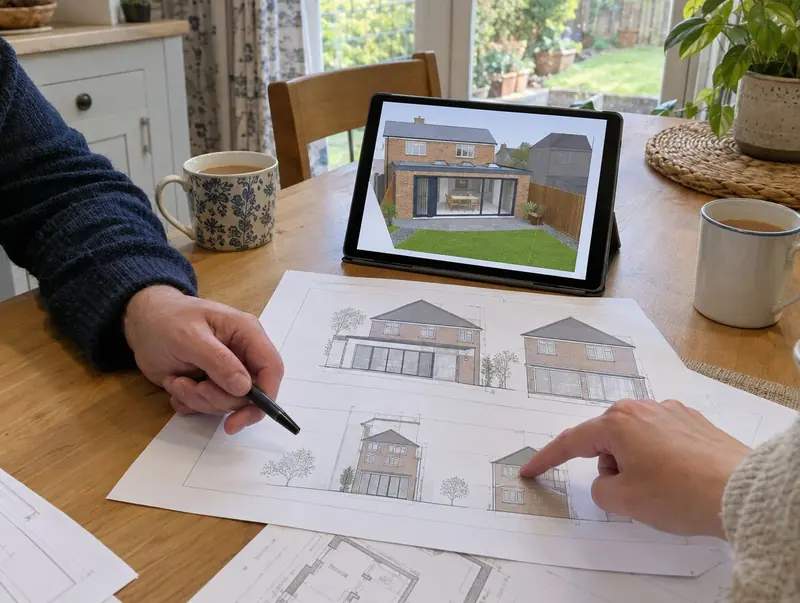
Planning permission for an extension can follow one of several routes: permitted development (no application, ideally confirmed with a lawful development certificate), prior approval for a larger single-storey rear extension in England, or a full householder planning application.
Choosing the right route saves time and money. We check your property's history, any conservation area or Article 4 restrictions and the limits that apply, then prepare and submit the application and deal with the council until a decision is issued.
What is included
- Planning history and constraints check for your address
- Route recommendation in writing
- Application forms, plans and supporting statements
- Submission and fee payment guidance
- Liaison with the planning officer
- Advice if conditions are attached or changes are requested
Who it suits
- Anyone unsure whether their extension needs permission
- Projects in conservation areas or with previous refusals
- Homeowners who would rather not deal with the council themselves
Design advice
A lawful development certificate is not compulsory for permitted development, but it is the cleanest proof that the extension was lawful when you come to sell. We usually recommend one.
How much does it cost?
National guide prices including VAT at 20%. Your area page shows prices adjusted for your region.
| Option | What it covers | Guide price |
|---|---|---|
| Essential | Permitted development confirmed in writing (certificate or notification) | £350 – £650 |
| Standard | Householder planning application handled | £600 – £1,100 |
| Premium | Application with heritage or design statements, and responses to the council | £900 – £1,600 |
Our handling fee only. Council fees are extra: in England from 1 April 2026 a householder application is £548, a lawful development certificate for a proposed extension £274 and a larger home extension prior approval £249. Drawings are priced separately.
Planning rules across the UK
England
In England the main routes are permitted development (ideally confirmed with a lawful development certificate, £274), larger home extension prior approval (£249, 42 days) and a householder planning application (£548, normally 8 weeks), with council fees as set from 1 April 2026.
Wales
In Wales the routes are permitted development (a lawful development certificate is available), or a householder planning application to the council. Wales has no prior approval scheme for larger rear extensions, and fees are set by the Welsh Government.
Scotland
In Scotland the questions are whether the extension falls within householder permitted development (Classes 1A to 1D) or needs planning permission from the council, and the building warrant, which is required before construction begins and is followed by a completion certificate.
Northern Ireland
In Northern Ireland we check the permitted development limits for your house type and, where needed, apply to your council for planning permission, then submit full plans or a building notice to council building control.
Building regulations and neighbours
Building regulations approval is separate from planning. In England you can use the council's building control team or a registered building control approver; a full plans application gets the drawings checked before work starts, and the inspector signs the work off with a completion certificate.
In England and Wales, if the work involves a shared wall, building on the boundary, or digging foundations within 3 m (sometimes 6 m) of a neighbour's building, the Party Wall etc. Act 1996 applies and notice must be served before work starts: two months for work to a party wall, one month for new walls on the boundary and for excavations. Scotland and Northern Ireland have no Party Wall Act.
Questions about planning permission for extensions
How long does planning permission take for an extension?
Councils in England aim to decide householder applications within 8 weeks of validation. Prior approval for a larger home extension has a 42-day determination period. Councils should decide lawful development certificate applications within 8 weeks, unless a longer period is agreed.
How much does planning permission cost?
In England, from 1 April 2026 the council fee is £548 for a householder application, £274 for a lawful development certificate for a proposed extension and £249 for larger home extension prior approval. Our handling fee is separate.
What happens if planning is refused?
You can revise the design and reapply, or appeal. We read the officer’s report and tell you honestly which option has a better chance.
Do the rules differ in Wales, Scotland and Northern Ireland?
Yes. Each nation has its own permitted development rules and fees. We apply the rules for your address.
How a project runs
Free site visit
We visit your home, measure up, talk through what you want and check the planning position.
Design and approvals
We draw the design, agree it with you and handle planning or permitted development checks and building regulations.
Fixed written price
With the design and specification agreed, you get a fixed written price and a start date.
Build and sign-off
We build it with one project manager, book the building control inspections and hand over the completion certificate.
Planning permission for extensions by area
- Bedfordshire
- Berkshire
- Bristol
- Buckinghamshire
- Cambridgeshire
- Cheshire
- Cornwall
- Cumbria
- Derbyshire
- Devon
- Dorset
- County Durham
- East Riding of Yorkshire
- East Sussex
- Essex
- Gloucestershire
- Greater London
- Greater Manchester
- Hampshire
- Herefordshire
- Hertfordshire
- Isle of Wight
- Kent
- Lancashire
- Leicestershire
- Lincolnshire
- Merseyside
- Norfolk
- North Yorkshire
- Northamptonshire
- Northumberland
- Nottinghamshire
- Oxfordshire
- Rutland
- Shropshire
- Somerset
- South Yorkshire
- Staffordshire
- Suffolk
- Surrey
- Tyne and Wear
- Warwickshire
- West Midlands
- West Sussex
- West Yorkshire
- Wiltshire
- Worcestershire
- Clwyd
- Dyfed
- Gwent
- Gwynedd
- Mid Glamorgan
- Powys
- South Glamorgan
- West Glamorgan
- Aberdeen and Aberdeenshire
- Angus and Dundee
- Argyll and Bute
- Ayrshire
- Dumfries and Galloway
- Dunbartonshire
- Edinburgh and the Lothians
- Fife
- Forth Valley
- Glasgow
- Highlands and Islands
- Lanarkshire
- Moray
- Perth and Kinross
- Renfrewshire and Inverclyde
- Scottish Borders
- County Antrim
- County Armagh
- County Down
- County Fermanagh
- County Londonderry
- County Tyrone
Related extension types
Extension plans and drawings
Measured survey, design options, planning drawings and building regulations drawings.
Learn more →Building regulations for extensions
Drawings, structural calculations and inspections so your extension is signed off properly.
Learn more →Double-storey extensions
Two floors in one build: a bigger ground floor and extra bedrooms or a bathroom upstairs.
Learn more →Wraparound extensions
An L-shaped extension across the side return and the rear, for the biggest open-plan ground floor.
Learn more →Need planning permission for extensions?
Book a free site visit: we measure up, check the planning route and give honest guide figures.
- Free, no-obligation site visit
- Planning route checked before you spend on drawings
- Written price once the design is agreed
- Building control sign-off at the end
Prefer to talk? Call 0800 088 6341 or .
Book a free site visit
Tell us a little about the project and we will arrange a time.